
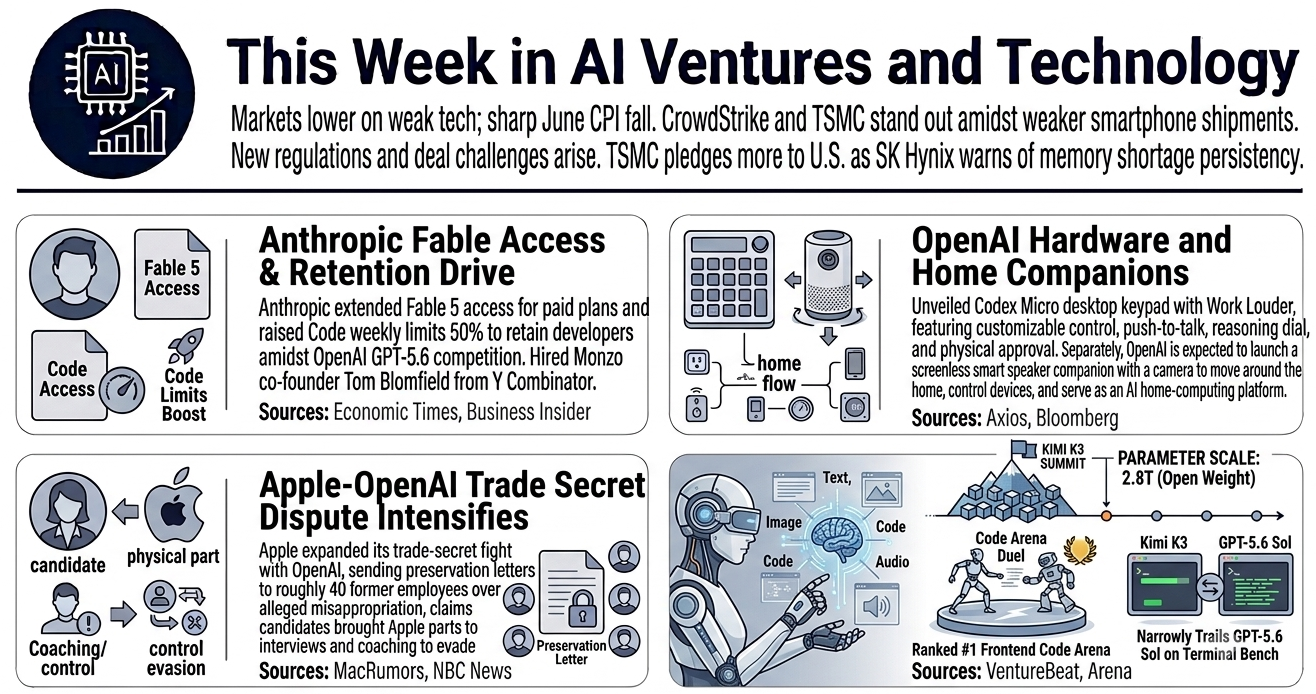

Markets turned lower on Thursday as the Nasdaq fell 1.5% and the Dow slipped 0.2%. June CPI fell 0.4%, its sharpest drop since 2020, though annual inflation held at 3.5%, while U.S.-Iran tensions continue to pressure the Strait of Hormuz. SpaceX briefly fell below its $135 IPO price on Wednesday, closing at $135.27 after losing 40% from its June peak. IBM plunged 25% after its unexpected preliminary earnings as customers shifted budgets from software toward servers and memory, while CrowdStrike gained 12% and Okta 11% amid mounting cyber risks. Regulators imposed New York City’s click-to-cancel rules and challenged Paramount Skydance’s $110B Warner Bros. Discovery deal. Stripe and Advent offered $53B for PayPal, valuing the company at a 28% premium. Smartphone shipments hit their weakest Q2 since 2013. TSMC committed another $100B to U.S. manufacturing after Q2 profit jumped 77%, lifting its 2026 revenue growth outlook above 40%, while SK Hynix warned memory shortages may persist beyond 2030.
Top 5 AI Highlights
[1] 🧪 Anthropic extended Fable 5 access for all paid Claude plans through July 19 and kept Claude Code weekly rate limits 50% higher, a developer-retention move after repeated access extensions and amid tougher competition from OpenAI’s GPT-5.6 on coding and reasoning benchmarks. Separately, Anthropic hired Monzo and GoCardless co-founder Tom Blomfield as a member of technical staff on its compute team, from Y Combinator. More from Economic Times and Business Insider.
[2] 🛠️ Anthropic and Blackstone unveiled Ode with Anthropic, a $1.5B AI implementation joint venture built on acquired startup Fractional AI with 100 engineers, betting enterprise value will accrue to teams that rewire core business processes rather than model providers alone; the Claude-first firm may use rival models when needed. Separately, Anthropic is arranging investor meetings through the banks leading its offering in the coming weeks ahead of a potential October IPO. More from TechCrunch and CNBC.
[3] ⌨️ OpenAI unveiled Codex Micro, a limited-edition desktop keypad built with Work Louder that pairs customizable controls, push-to-talk, a reasoning dial, and physical approval inputs. Separately, OpenAI’s first hardware device is expected to be a battery-powered, screenless smart speaker that can move around the home, use an integrated camera, control connected devices, and serve as a humanlike AI companion, positioning ChatGPT as a new home-computing platform. More from Axios and Bloomberg.
[4] ⚖️ Apple has expanded its trade-secret fight with OpenAI by sending legal preservation letters to roughly 40 former employees, signaling that alleged misappropriation may extend beyond the two ex-workers named in its lawsuit, which claims candidates brought physical Apple parts to interviews and employees were coached to evade exit controls; NBC News separately reported OpenAI addressed Apple’s concerns, but discussions stalled after outside counsel confused two similarly named employees, raising legal and recruitment risks in the intensifying AI talent war. More from MacRumors and NBC News.
[5] 🏗️ Meta will invest more than $50B to expand its Louisiana data center to 5GW of compute capacity, one of the world’s largest AI infrastructure projects, with an energy agreement expected to save Entergy customers more than $2B over 20 years. Separately, New York became the first U.S. state to pause new hyperscale data-center construction, imposing a one-year moratorium on projects using 50MW or more. More from CNBC and Forbes.
✨Open Source AI Development
[1] 🧠 Thinking Machines Lab released Inkling, its first open-weight model, a 975B-parameter mixture-of-experts system that activates 41B parameters per task and was trained on 45T multimodal tokens, positioning Mira Murati’s lab around customizable enterprise AI rather than one-size-fits-all frontier models. More from TechCrunch.
[2] 💰 DeepSeek is seeking $1.5B at a $71B valuation and could file for an IPO as early as late 2026, with annualized revenue nearing $500M after rapid adoption of its open-source models sharpened investor interest. More from TechCrunch and The Information.
[3] 🤖 Moonshot AI released Kimi K3, a 2.8T-parameter multimodal reasoning model and the largest announced for open-weight release; it ranked #1 on Frontend Code Arena ahead of Claude Fable 5 and scored 88.3 on Terminal Bench 2.1, narrowly trailing GPT-5.6 Sol’s 88.8, with full weights due July 27. More from VentureBeat and Arena.
[4] 📱 Apple is in early talks to use PrismML compression to run larger AI models on iPhones, with its Bonsai 27B built from Alibaba’s open-source Qwen3.6 27B, then compressed after training into a 3.9GB 1-bit model that fits on an iPhone 17 Pro while retaining roughly 90% of the full-precision model’s benchmark performance, potentially strengthening Apple’s on-device AI strategy. More from CNBC / PrismML.
[5] ⚡ Reflection AI signed a computing agreement worth more than $1B with Nebius through 2029, securing Nvidia’s latest chips to train open models and highlighting the capital intensity of competing with closed frontier labs. More from Reuters.
Founder’s Corner
Latest Software Startup Fundraising Benchmarks

Source: X
What We Read This Week
- 29 countries signed an agreement to establish the Shanghai-based World AI Cooperation Organization, a China-backed intergovernmental body for AI cooperation and governance that could expand Beijing’s influence over global standards as U.S.- and China-aligned technology blocs diverge. (Reuters).
- Google DeepMind, OpenAI, and Anthropic’s CEOs converged on calls for frontier AI regulation, favoring pre-release evaluations and certification while disagreeing over who should have final authority, a framework that could entrench the largest labs because startups and open-source developers face higher compliance costs. (Axios).
- Google DeepMind launched a bioresilience program with Isomorphic Labs to use frontier AI for pathogen surveillance, vaccine and therapeutic design, and outbreak response, while pledging to withhold models if biological capabilities outpace safeguards. (Axios).
- Microsoft CEO Satya Nadella described a “reverse information paradox” in enterprise AI, warning companies may pay twice, first in token fees and then by surrendering proprietary prompts, corrections, and institutional knowledge, and urged buyers to own their learning data and use multi-model orchestration to avoid vendor lock-in. (X).
- JPMorgan’s eight AI allocation agents all beat a traditional 60/40 portfolio on a risk-adjusted basis in two-decade backtests, with the best model adding 0.7 percentage point annually at lower volatility, though the bank cautioned the results remain historical simulations rather than live performance. (Bloomberg).
- Lyzr used one of its own AI agents to manage investor outreach for a planned $100M Series B at a roughly $500M valuation, responding to 130+ investors and helping draft dozens of memos as the enterprise-agent startup attracted $400M of interest. (Bloomberg).
- Vercel’s July AI Gateway index showed open models reached 29% of token volume on under 4% of spend, up from 11% in April, while DeepSeek captured 22.6% of tokens and Anthropic took 61% of spending, underscoring how low-cost open weights are reshaping enterprise model usage. (Vercel).
- China’s new rules for emotionally interactive AI, effective July 15, require age checks, safety reviews, and restrictions on virtual intimate relationships for minors, prompting ByteDance’s Doubao and Alibaba’s Qwen to disable companion features as Beijing links chatbot attachment to falling marriage and birth rates. (WSJ)
- Kalshi’s real-time World Cup prediction-market odds are now appearing in ChatGPT responses, giving users event probabilities without enabling wagers inside the chatbot and extending the exchange’s push to distribute its data through mainstream consumer platforms. (New York Times)
- Bending Spoons received 800K job applications in 2025 and hired just 286 people, a sub-0.04% acceptance rate, showing how the Milan-based owner of AOL, Evernote, and Vimeo uses a highly selective, data-driven hiring machine to support its lean software acquisition model. (WSJ)
- Airbnb’s World Cup push helped add 52K+ short-term rentals in U.S. host cities, lifting supply 12% and pulling fans away from hotels, which raised rates around 20% but saw weaker occupancy and lower revenue expectations in markets like New York. (FT)
- Uber agreed to acquire Delivery Hero for $14.8B, nearly doubling the markets where it offers both rides and delivery and expanding the combined footprint to 99 countries; businesses in 14 overlapping markets will be sold to SSW Partners for about $1.6B to reduce antitrust concerns. (TechCrunch)
AI Fundraising News (Jul 10 — Jul 16)
- Adapter: AI agent data access company, raised $17.8M
- American Growth Insurance: AI insurance transformation company, raised ~$70M
- Applied Computing: AI energy operations models company, raised $20M
- Augmodo: AI retail inventory camera company, raised $21M
- Beacon Security: AI agentic security company, raised a $13M seed
- Bunkerhill Health: AI hospital operations agents company, raised a $25M Series B
- Chai Discovery: AI drug discovery company, raised $400M
- Csquare: AI data center infrastructure company, raised $1.05B in an IPO
- CXMT: AI memory chip company, is seeking to raise ~$9.8B in an IPO
- Databricks: AI data and analytics platform with strong AI capabilities, raised $3.0B
- DeepSeek: AI open-source language model company, is seeking to raise $1.5B
- Emerald AI: AI data center management software company, is in talks to raise at least $100M
- Emergent: AI vibe coding company, raised $130M
- Feathery: AI insurance workflow automation company, raised $30M in total funding
- Finto: AI accounting automation company, raised a $3.4M seed
- Fireworks: AI open-model infrastructure company, raised $1.5B
- Flex: AI business finance and payments company, raised a $70M Series B1
- Gradium: AI voice technology company, raised a $30M seed extension
- Guthrie AI: AI construction bidding company, raised a $4M seed
- Hadrius: AI financial compliance company, raised a $22M Series A
- Helsing: AI defense technology company, raised $1.8B
- Hemispheric: AI brain activity diagnostics company, raised $52M
- Hostie: AI restaurant virtual concierge company, raised a $12M Series A
- Instalily AI: AI forward-deployed engineering company, raised a $60M Series B
- Kapture CX: AI enterprise customer support company, raised $10M
- LimX Dynamics: AI humanoid robotics company, raised $200M
- Marker: AI writing collaboration company, raised a $13M seed
- Microagi: AI humanoid robotics training data company, raised a $55M seed
- Miles Wang’s startup: An AI drug discovery company founded by the OpenAI researcher, is in talks to raise $200M
- Monumental: AI construction robotics company, raised a $32M Series B
- Neko Health: AI full-body scanning company, raised $700M
- Nous Research: AI open-source agents and models company, is reportedly finalizing a $75M+ round
- Oak: AI identity and access management company, raised a $60M seed
- Overtone: AI voice-first dating company, raised $18M
- Pearl Health: AI value-based care company, raised $110M
- PixVerse: AI video and virtual world company, raised a $439M Series C
- Prolo: AI construction procurement company, raised a $5.6M seed
- Pulse Security AI: AI cybersecurity program management company, raised an $8M seed
- Rime: AI enterprise voice model company, raised a $24M Series A
- Runta: AI agent sandbox and guardrails company, raised a $20M seed
- Sable: AI website product demo agent company, raised $45M
- Self Inspection: AI vehicle damage assessment company, raised $10M
- Skalar: AI tax and accounting company, raised a $13.7M pre-seed
- Spectro Cloud: AI infrastructure cost management company, raised a $100M+ Series D
- State Affairs: AI regulatory intelligence company, raised $70M
- Thira: AI back-office automation company, raised a $21M seed
- TYLsemi: AI custom chip design company, raised $43M in early-stage funding
- TytoCare: AI remote physical exam company, raised a $25M+ growth round
- Valarian: AI cloud data-control company, raised a $50M Series A
- Walden Robotics: AI general-purpose industrial robotics company, raised $300M