
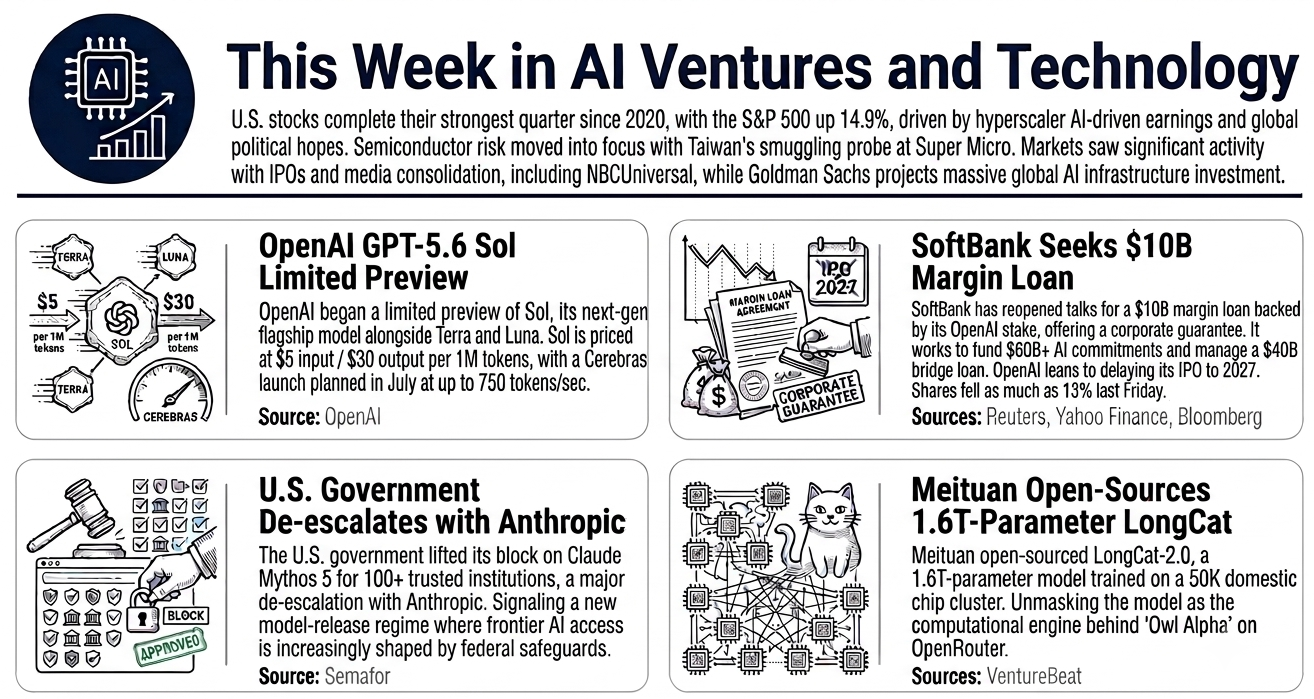

Stocks posted their strongest quarter since 2020, with the S&P 500 up 14.9% through June on strong AI-driven hyperscaler earnings and hopes for an end to the U.S.-Iran war. U.S. job creation cooled in June with payrolls growth of just 57,000; unemployment rate at 4.2%. Semiconductor risk also moved into focus as Taiwan expanded a chip-smuggling probe with an office investigation at a Super Micro location. In tech and public markets, Getty Images plans to end its $3.7B Shutterstock merger after U.K. CMA conditions threatened the deal, while Bending Spoons priced its Nasdaq IPO at an $18.4B valuation and Lime’s shares closed up 4% in its Nasdaq Debut on Wednesday, valuing the company at $1.7B and raising $174M. Comcast’s NBCUniversal split underscores pressure on legacy media to sharpen portfolios. Goldman Sachs is also pushing AI into the physical economy, forecasting $7.6T of global AI infrastructure investment from 2026 to 2031. Lastly, as reported by the Financial Times, OpenAI proposes handing the Trump administration a 5% stake in the company.
We’ve published our Monthly AI Deck for June 2026. Check it out here.

Top 5 AI Highlights
[1] ⚡ OpenAI began a limited preview of GPT-5.6 Sol, its flagship next-generation model alongside Terra and Luna, with Sol priced at $5 input / $30 output per 1M tokens and a Cerebras launch planned at up to 750 tokens/sec in July, underscoring intensifying frontier model and inference competition. More from OpenAI.
[2] 💸 SoftBank has reopened talks for a $10B margin loan backed by its OpenAI stake, offering a corporate guarantee to ease lender concerns over private-company collateral as it works to fund more than $60B of AI commitments and manage a $40B bridge loan due March 2027. Separately, OpenAI is reportedly leaning towards delaying its IPO until 2027. Softbank shares fell as much as 13% last Friday. More from Reuters, Yahoo Finance, and Bloomberg.
[3] 🛡️The U.S. government lifted its block on Anthropic’s Claude Mythos 5 for more than 100 trusted institutions, marking a major de-escalation with Anthropic while signaling a new model-release regime where frontier AI access is increasingly shaped by federal safeguards. More from Semafor.
[4] ☁️ Google reportedly capped Meta’s use of Gemini as AI demand strains capacity, underscoring how compute scarcity is becoming a strategic bottleneck even for the largest tech platforms and a potential constraint on enterprise AI adoption. More from Financial Times.
[5] 📈 Amazon raised prices for EC2 Capacity Blocks for ML (which lets companies reserve GPUs in advance) by roughly 20% starting in July after a 15% January hike, underscoring how scarce GPU capacity and memory-chip pressure are giving hyperscalers more pricing power in AI cloud infrastructure. More from Business Insider.
✨Open Source AI Development
[1] 💸Brian Armstrong said Coinbase is experimenting with open-weight models like GLM 5.2 and Kimi 2.7 through its LLM gateway, alongside model routing, caching, leaner context and spend visibility, showing how enterprises are using open models to keep AI usage high while lowering inference costs. More from X.
[2] 🤖 Together AI raised $800M at an $8.3B valuation as enterprise demand for cheaper open-source AI inference accelerates, with the company’s revenue run rate reaching $1.2B and token processing up 10,000x over the past year as firms shift workloads from costly closed models to lower-cost open alternatives. More from the NY Times.
[3] 🧩 Meituan, a Chinese food delivery giant, open-sourced LongCat-2.0, a 1.6T-parameter model it says was trained on a 50K-chip cluster of domestic Chinese processors. Unmasking the model as the computational engine behind “Owl Alpha,” the anonymous stealth model that has spent the last two months commanding global developer charts on OpenRouter. More from VentureBeat.
[4] 🛡️ NVIDIA and Palantir announced a deal to bring secure sovereign AI infrastructure to U.S. government agencies and critical industries, integrating NVIDIA Nemotron open models into air-gapped, NVIDIA-powered infrastructure to support customer-owned data, model weights, auditability, and lower-cost customization for sensitive government missions. Palantir’s CEO also spoke on CNBC about how “something has gone completely wrong“ with how AI is sold. More from NVIDIA and YouTube.
[5] ⚡ DeepSeek detailed DSpark, a speculative decoding framework for its V4 models that it says can speed AI inference by up to 85% and was tested on Gemma and Qwen, pointing to lower-cost open model deployment as inference bottlenecks and chip constraints intensify. More from South China Morning Post.
Founder’s Corner
$110B TTM Revenue for Gen AI Economy and on pace to $175B

Source: Exponential View
What We Read This Week
- California Gov. Gavin Newsom struck a deal with Anthropic to expand Claude across state agencies and local governments, giving public-sector users discounted access plus training and technical support and signaling how frontier AI vendors are moving deeper into government workflows. (Politico).
- SpaceX is set to join the Nasdaq-100, opening the door to a wave of passive buying from index-tracking funds and turning its newly public stock into a test case for how AI-adjacent infrastructure leaders can reshape major benchmarks. (Reuters).
- U.S.-blacklisted Chinese cybersecurity firm Qihoo 360 claimed it built Tulongfeng, an AI vulnerability discovery system it calls a Chinese version of Anthropic’s restricted Mythos, saying it found 3,000+ flaws and highlighting how frontier cyber-AI tools are becoming strategic assets in the U.S.-China tech rivalry. (The Telegraph).
- Digital Realty is buying Blackstone’s data center stake in a deal valuing the assets at $7.8B, reinforcing how AI-driven demand is pulling strategic capital back into data center ownership and giving operators more control over scarce infrastructure. (Reuters).
- Salesforce staff reportedly worry Anthropic’s Claude Tag could cannibalize Slackbot and give Anthropic more leverage over enterprise software, highlighting how AI assistants are becoming a competitive control point inside productivity platforms. (The Information).
- FIFA and World Cup organizers are navigating sponsor and stadium branding conflicts as the tournament’s commercial scale grows, highlighting how global sports rights are becoming more complex and lucrative as brands compete for visibility around 2026 venues. (WSJ).
- Meta is reportedly exploring a prediction markets app to rival Polymarket and Kalshi, showing Zuckerberg’s push to chase emerging consumer behavior while raising new questions around betting, regulation and platform-driven distribution. (New York Times).
- Meta named longtime CMO Alex Schultz as its first chief data officer, making analytics, data infrastructure and the AI “context layer” a formal C-suite priority as the company pushes to improve model reasoning and internal decision-making. (Axios).
- Meta is reportedly building a cloud business to sell excess AI compute, a pivot that could monetize its heavy data center spending while pressuring neocloud providers and signaling hyperscalers may turn surplus AI capacity into a new revenue line. (Bloomberg).
- Visa, Stripe, Coinbase and 140+ partners are backing Open USD, a new reserve-revenue-sharing stablecoin set to launch later this year, positioning OUSD as a business-focused payment asset with no mint/redeem fees, shared governance and native issuance on Tempo from day one. (The Block).
AI Fundraising News (Jun 26 — Jul 1)
- 1001: AI critical infrastructure company, raised a $30M Series A
- 8090 Labs: AI enterprise coding agent company, raised a $135M Series A
- AI2 Robotics: AI humanoid robotics company, raised $735M
- Apptronik: AI humanoid robotics company, raised $1B
- Arato: AI systems evaluation company, raised a $10M seed round
- Baz: AI code planning company, raised a $9M seed extension
- Build: AI infrastructure due diligence company, raised an $8.5M seed
- Cognite: Norwegian industrial AI software firm, acquired by Schneider Electric for $3.1B
- Etched: AI chip company, raised $800M
- GenerativeX: AI enterprise deployment company, raised a $4M Series A
- Higharc: AI homebuilding software company, raised a $95M Series C
- Hypefy AI: AI influencer marketing company, raised a $7.2M Series A
- Jota: AI digital banking company, raised a $30M Series A
- MDOTM: AI asset and wealth management software company, raised $27M
- MGX: AI investment fund company, raised $49B
- Nomerra: AI private markets operations company, raised $2M
- Omen AI: AI fluid monitoring sensors company, raised a $31M Series A
- Pie: AI small business marketing company, raised a $19.5M Series A
- Pocket: AI note-taking device company, raised $11M
- Quantifind: AI financial crime detection company, raised $200M
- Saltroad: AI speech therapy documentation company, raised £1.5M
- Sazabi: AI production issue remediation company, raised an $8M seed round
- Straiker: AI agent security company, raised a $64M Series A
- Together AI: AI open-source model access company, raised $800M
- Twelve Labs: AI video understanding company, raised a $100M Series B
- Venice AI: AI private model access company, raised a $65M Series A