
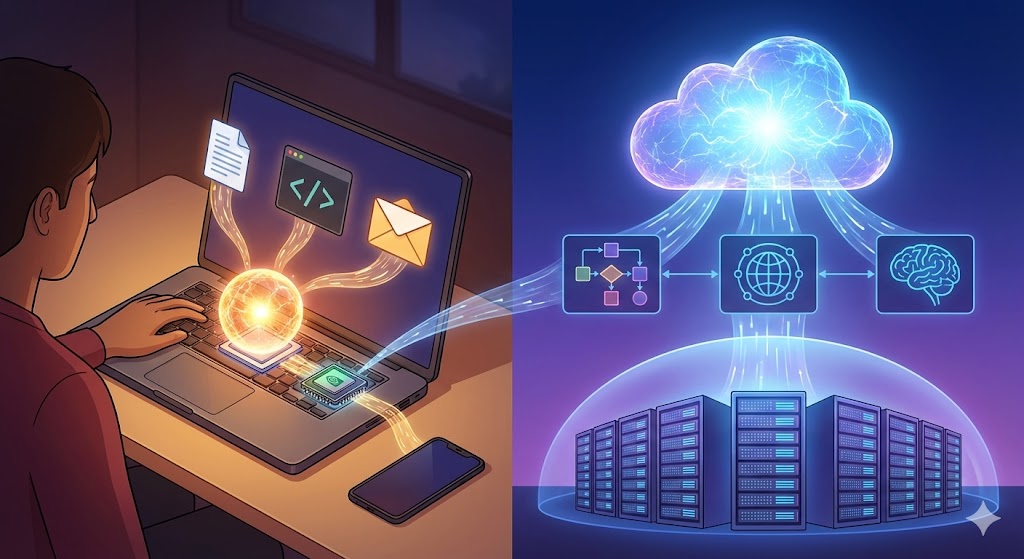
Open Source Catches Up, and Consumer Hardware Is Ready
Open-source large language models have quietly caught up to their closed-source cousins. Models like OpenAI’s gpt-oss-20B, Meta’s Llama, and many models coming out of China can now deliver reasoning, code generation, and conversational ability that would have seemed like science fiction three years ago. And they’re free to download!
The catch? Running them still requires serious hardware. Today, a $1,000 Nvidia RTX 5080 with 16GB of VRAM can comfortably run gpt-oss-20B locally, producing results that rival cloud-hosted models for everyday tasks like drafting emails, summarizing documents, or debugging code.
That’s impressive, but it’s also a preview of something bigger: the hardware that feels premium today will be standard-issue within five years. Just as SSDs migrated from enthusiast builds to budget laptops, powerful local inference is on a predictable path toward ubiquity.
Data Centers Won’t Sit Idle. They’ll Think Longer
So what happens when hundreds of millions of PCs can run capable AI models without ever pinging a server? One reasonable fear is that data centers built for inference will sit idle, becoming expensive paper weights to demand that has moved on-device. But that’s probably not how it plays out.
The more likely scenario is a division of labor: routine, latency-sensitive tasks are handled on-device, while the neoclouds take on longer, more complex work. Think agentic AI that researches, plans, and executes multi-step workflows over hours rather than minutes.
If today’s “Deep Research” features can produce a detailed report in 10 minutes, imagine what can be possible with hours of compute and a sophisticated agent orchestrating the process. Local models handle the quick stuff while cloud models handle the intensive stuff.
Basic AI Goes Local. The Cloud Becomes the Heavy Lifter
The AI most people interact with today (chatbots, voice assistants, simple copilots) will eventually run entirely on the devices in their pockets and on their desks. That’s the baseline I’d expect in a few years.
The real value proposition for cloud infrastructure will shift toward capabilities that local hardware simply can’t replicate: sustained reasoning, massive context windows, and coordinated multi-agent systems.
There’s also room for a new category of consumer device, something purpose-built to tap into cloud AI for tasks that demand more than any local chip can offer. Think of how smartphones already offload photo processing and backups to the cloud. The future isn’t local versus cloud. It’s local for the ordinary, cloud for the extraordinary.
For further reading, visit the following links related to open-source development:
[1] https://ollama.com/
[2] How to install Ollama guide: https://medium.com/@sridevi17j/step-by-step-guide-setting-up-and-running-ollama-in-windows-macos-linux-a00f21164bf3
 Stepmark Partners