

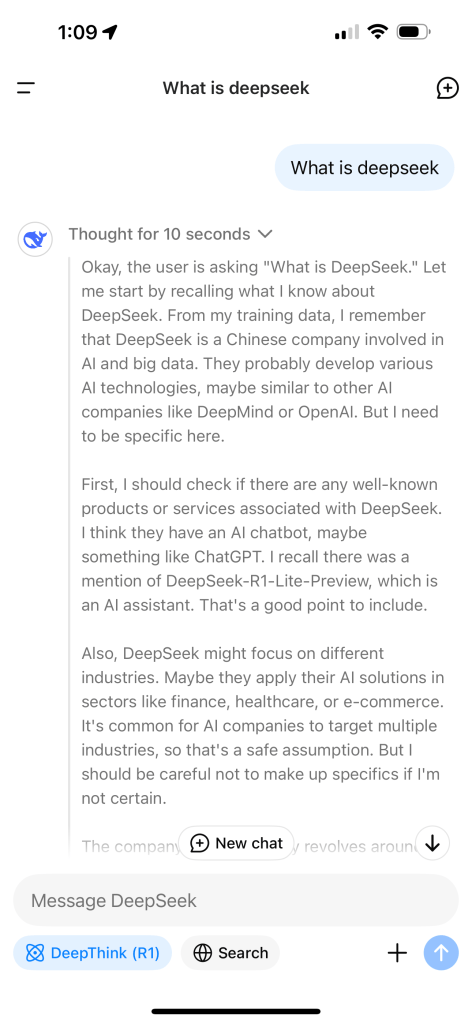

Over the past month, and especially in the past 48 hours, a Chinese company called DeepSeek has been creating an unexpected divide in Silicon Valley, as industry leaders grapple with the economics of an evolving landscape.
Companies like OpenAI and Google have invested billions in developing advanced AI models, only to find themselves shouldering the entire financial burden while competitors benefit from their innovations through a process called “distillation”. This dynamic has begun to reshape the technology industry’s competitive balance. Some quick thoughts below:
Microsoft, which recently weathered a public separation from OpenAI (see Satya’s interview at Davos: “I’m good for my $80 billion”), has shown increasing reluctance to fund the extensive infrastructure required for developing cutting-edge AI models. This has led to OpenAI pursuing a deal it announced with Oracle last week (see “Stargate”). Microsoft’s hesitation reflects a growing awareness that such investments may become commoditized long before the assets are fully depreciated. DeepSeek’s breakthrough all but confirms this.
DeepSeek’s new development presents varying opportunities for Big Tech. Apple, perhaps, is the biggest beneficiary of all this. The company’s advanced chip design makes it uniquely positioned to run sophisticated AI directly on iDevices (some users have reported running DeepSeek on high end Macs). In theory, edge computing approach not only enhances user privacy but also significantly reduces operational costs compared to cloud-based alternatives.
Amazon’s cloud computing division, despite lacking its own premier AI model, can now offer high-quality open-source model alternatives at significantly reduced costs.
Meta appears poised to benefit significantly from reduced operational costs as AI becomes more efficient (note: they already have AI deeply embedded in advertising operations).
Google, long considered a leader in AI research, faces unique challenges. Its proprietary AI hardware advantages (from its TPUs) reduces the relative advantage from decreased hardware usage from more efficient models while the likelihood of search alternatives increase (e.g., Perplexity or a frontier model’s real-time Search capability).
These current developments suggest a fundamental restructuring of competitive dynamics, where the ability to efficiently deploy AI may prove more valuable than the capacity to develop it.
Overall, the lower costs of AI and increased accessibility are great news for developers. With reduced expenses and broader model selection, 2025 looks promising for building AI-powered applications.
FWIW, I think it’s still too early to say whether open or closed source wins. The future is still being built and we’re seeing tremendous agentic development progress — chatbots are just an appetizer!

 Stepmark Partners