

Table of Contents
- Introduction
- Historical Fragmentation of Education Tools
- The Emergence of Integrated AI Solutions
- Enhancing Knowledge Transfer with AI
- Benefits of AI in Education
- Challenges of AI in Education
- AI’s Role in Preventing Plagiarism and Cheating
- Looking Forward
Introduction
The EdTech landscape is experiencing a seismic shift, catalyzing unprecedented market disruptions. While the sector previously thrived on fragmented point solutions—each addressing niche academic needs—the AI revolution has rendered many legacy tools obsolete. This technological displacement presents both opportunities and risks for investors: established EdTech players must either pivot to AI integration or risk market share erosion, while AI-native startups are capturing growing wallet share in this $342 billion market. With traditional education technology rapidly becoming commoditized, strategic M&A activity and AI capabilities are emerging as key differentiators for sustainable growth and investor returns.
Historical Fragmentation of Education Tools

- In the 2000s to 2010s, students relied on Chegg and Course Hero for homework assistance, turning to them whenever they faced challenging assignments.
- To supplement their secondary language learning from school, students used Duolingo and Rosetta Stone, which made practicing new languages more accessible, fun and engaging.
- CliffsNotes and SparkNotes were constant go-tos as students navigated traditional English texts like The Odyssey, Beowulf, and the works of Shakespeare.
- When it came to solving trigonometry and calculus problems, Wolfram Alpha was always open on laptop screens.
- Additionally, platforms like Moodle, Canvas, and Blackboard became integral to academic lives, helping students track class schedules, assignment grades, and GPAs.
The Emergence of Integrated AI Solutions
Foundation models with advanced reasoning capabilities have revolutionized academic support, replacing fragmented tools with unified, intelligent solutions. LLMs, such as ChatGPT and Claude, offer sophisticated cross-disciplinary assistance from math to English, while RAG-enhanced systems like Perplexity AI are making traditional search and reference tools increasingly obsolete.

From a macro perspective, artificial intelligence is transforming edtech across multiple subsectors. Impacting language learning, STEM education, and test preparation, while expanding into emerging areas like mental health support and social-emotional learning.
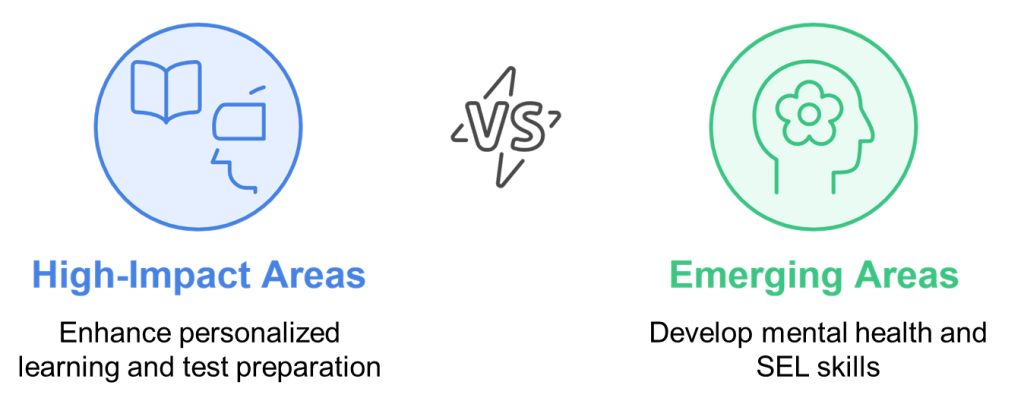
- Language Learning: Duolingo has introduced AI-powered features to offer personalized instruction and adaptive learning pathways.
- STEM Education: Systems such as ALEKS utilize AI to tailor math and science education with customized problem sets.
- Test Preparation: AI-powered tools like Google’s NotebookLM provide individualized study plans and practice questions using input notes, tests, class syllabus and other documents.
- Mental Health Support: AI chatbots like Woebot and Character AI deliver cognitive-behavioral therapy techniques.
- Social and Emotional Learning (SEL): AI applications are beginning to address SEL by teaching empathy, collaboration, and communication skills through virtual interactions.
Enhancing Knowledge Transfer with AI
Traditional education companies have integrated AI capabilities into their products to remain competitive as artificial intelligence transforms the industry.

- Adaptive Learning Platforms: Companies like DreamBox Learning tailor lessons to individual student needs, creating personalized learning trajectories.
- Interactive Learning Tools: Platforms such as Desmos enhance mathematical understanding through interactive visualization.
- Supporting Diverse Learning Needs: AI provides customized experiences for niche student groups, including neurodivergent and disabled students.
- Learning Management Systems: Platforms like Canvas incorporate AI for automated grading and insights into student performance.
- Assessment Tools: Solutions like Gradescope utilize AI to expedite grading and plagiarism detection, enabling immediate feedback.
Benefits of AI in Education
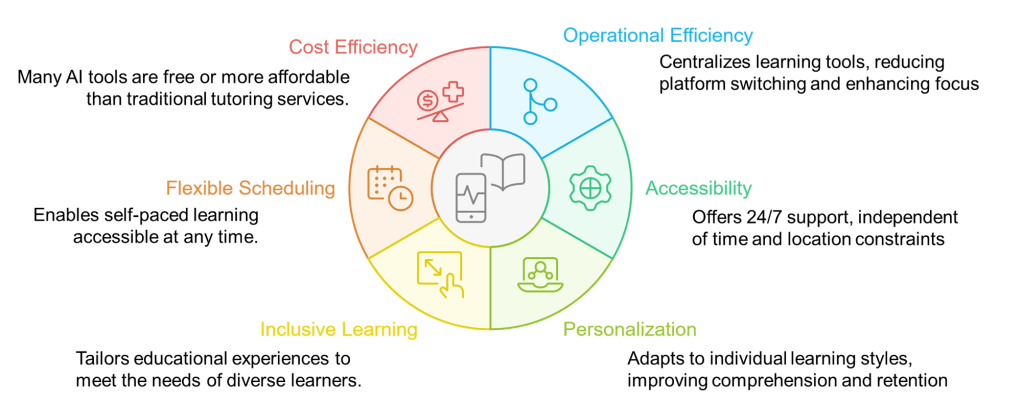
AI enhances education by improving accessibility, offering cost efficiency, enabling flexible scheduling, promoting inclusive learning, increasing operational efficiency, and providing personalization to tailor education to individual needs.
Challenges of AI in Education
While AI integration offers significant benefits to education, it also presents challenges such as data privacy concerns, dependence on technology that may hinder critical thinking, the necessity for digital literacy skills, educational disparities due to unequal access, and potential erosion of social interaction.

AI’s Role in Preventing Plagiarism and Cheating
AI has reshaped academic assignments by providing students access to free or low-cost, easy-to-use tools to create original work and to get instant answers with step-by-step instructions on math questions.
When used properly, these powerful tools are most valuable to support and refine a student’s ideas. Today, chatbots are best used to assist with grammar, style, and insights, allowing students to produce more refined work. AI should be used as a support tool, just like how calculators are used to speed up analyses. Imagine a student working in parallel with AI to brainstorm ideas on writing an essay about world history versus being stuck in a rut and scrolling mindlessly on social media. AI can inspire new ideas and innovative approaches to learning.

The temptation to rely on AI for quick and easy answers can undermine the very essence of learning. By circumventing the critical thinking process, students risk losing the ability to solve problems independently and develop a deep understanding of the subject matter. In doing so, the student lacks the knowledge and critical thinking skills necessary to develop and grow. From the educator’s perspective, it can be difficult to distinguish between AI and human-generated content, especially when there are dozens of papers to review. The arms race of detecting plagiarism, while creating AI tools to obscure provenance is never-ending.

When it comes to evaluating work, technology has always introduced new capabilities and created new challenges. Just like the calculator and Excel before it, AI will undoubtedly change the way students are evaluated and how educators modify their curriculum to accommodate this new technology.
- Learnosity allows teachers to create quizzes from students’ self-submissions, checking if students created the content themselves. It works like this: Students submit their work and immediately get a few questions generated from their submission. The point is, if a student can answer their own submitted work, they probably wrote it themselves.
- Turnitin’s advanced AI detection tools, which include an AI-paraphrasing detector and digital grading features, encourage ethical AI use by ensuring transparency. Turnitin has been the de facto plagiarism detection tool and is ramping up tools to detect AI-generated content.
- GPTZero helps students and educators identify AI-generated content, promoting integrity in assignments. There is a free option on the main page to submit text to get an evaluation.
Together, these tools enhance the learning process by supporting originality, reinforcing comprehension, and fostering accountability in academia
Looking Forward
While AI revolutionizes education through enhanced personalization and efficiency, the future of learning lies in thoughtful integration that preserves human connection. By fostering collaboration between educators and students in developing AI tools, we can harness technology’s benefits while maintaining the essence of knowledge transfer and critical thinking development.
 Stepmark Partners